Wondering how to start a Shopify store that Indian customers will actually buy from? Shopify is one of the fastest ways to launch a professional online store — but a store that looks like every other template rarely sells well. This guide explains what Shopify website design and development involve, when Shopify is the right choice, how to set it up for Indian customers, what affects the cost, and how to choose a Shopify agency in India.
Why brands choose Shopify
Shopify is a hosted ecommerce platform: it takes care of hosting, security, updates and the checkout, so you can focus on products and marketing. Brands choose it because it is reliable, easy for teams to manage, and backed by thousands of apps for reviews, subscriptions, loyalty, shipping and marketing. It suits direct-to-consumer brands, fashion and lifestyle labels, beauty and wellness products, and businesses that want to launch quickly and scale without managing servers.
Good Shopify website design turns that solid foundation into a store that reflects your brand, builds trust and makes buying effortless on a phone.
What our Shopify website design service includes
| Stage | What we deliver |
|---|---|
| Strategy | Store structure, collections, navigation and customer journey |
| Theme and design | A customised theme or custom sections that match your brand |
| Shopify store setup | Products, variants, collections, pages, policies and settings |
| Payments and shipping | Indian payment gateways, shipping zones, rates and courier apps |
| Apps | Reviews, WhatsApp chat, upsells, subscriptions and email tools |
| SEO | Titles, descriptions, clean URLs, structured data and redirects |
| Launch and training | Go-live checklist, analytics setup and a walkthrough for your team |
Our Shopify website development work covers everything from the first product upload to the first campaign.

How to start a Shopify store for Indian customers
A Shopify store for India needs a few specific settings to work well:
- Payment gateways. Shopify Payments is not available in India, so stores use third-party gateways such as Razorpay, PayU, Cashfree or PhonePe for UPI, cards, net banking and wallets. Shopify may charge an additional transaction fee on these payments depending on your plan, which should be part of your cost planning.
- Cash on delivery. Often essential for first-time customers, with rules to limit risky orders.
- Shipping. Courier apps and aggregators for rates, labels and tracking.
- GST. Tax settings and invoice apps that produce GST-compliant invoices.
- Language and currency. Rupee pricing for India, with international markets set up if you sell abroad.
Shopify’s own Help Center documents every setting; we configure them for you and explain the choices.
Shopify vs WooCommerce
| Shopify | WooCommerce | |
|---|---|---|
| Hosting and security | Included and managed | You choose and manage hosting |
| Ease of use | Very easy for teams | Easy, with more options to learn |
| Flexibility | High through apps and themes | Very high, including custom code |
| Costs | Monthly plan, app subscriptions, possible transaction fees | Hosting, plugins and maintenance |
| Content and blogging | Good | Excellent (built on WordPress) |
| Best for | Fast launches, D2C brands, lean teams | Content-led brands wanting full control |
Neither is always better. We compare both for your business during discovery, and also build WooCommerce stores when they fit better.
How much does a Shopify website cost in India?
The cost of Shopify website design depends on your theme (free, premium or custom), the number of products and collections, custom sections and features, the apps you need, content and product photography, and integrations such as ERP, marketplaces or custom shipping. Separately, you pay Shopify for your plan and any paid apps, and your payment gateway for transactions — all in your own name. We give a fixed quote for the design and setup with a written scope, so there are no surprises.

Features that make Shopify stores convert
- Fast, mobile-first theme with only the apps you really need.
- Strong product pages — multiple images, videos, size guides, delivery estimates and reviews.
- Collections that guide shoppers — by category, occasion, price or bestseller.
- Trust elements — clear policies, secure payment icons, contact details and social proof.
- Upsells and bundles — relevant add-ons that raise order value without annoying buyers.
- WhatsApp chat — quick answers before purchase, which matters to many Indian shoppers.
- Abandoned-cart recovery — email and WhatsApp reminders for unfinished orders.
Shopify for different types of brands
| Brand type | What the store needs |
|---|---|
| Fashion and apparel | Size and colour variants, size charts, lookbooks, easy exchanges |
| Beauty and wellness | Ingredient details, before-and-after reviews, bundles and subscriptions |
| Home and décor | Lifestyle photography, room-style collections, delivery timelines |
| Food and gourmet | Delivery zones, freshness details, gift boxes and festive collections |
| Jewellery and accessories | High-quality zoom images, trust badges, gift options, secure delivery |
Shopify website design for each of these looks different, because shoppers look for different reassurance before they buy.
Selling internationally with Shopify
Shopify makes it easier to sell outside India with multiple currencies, market-specific pricing, translated content and international shipping rates. Brands selling to the UAE, the USA or the UK can show prices in local currency and set delivery options per country. We set up international markets, duties and shipping carefully, because unexpected costs at checkout are one of the main reasons overseas shoppers abandon a purchase.
Shopify store setup checklist
Before any Shopify store goes live, we check:
- Store name, domain, email notifications and brand settings.
- Products with variants, prices, stock, weights and SEO fields.
- Collections, navigation menus and search.
- Payment gateway, cash on delivery rules and test orders.
- Shipping zones, rates and courier integration.
- Taxes, GST details and invoice app.
- Legal pages — privacy, terms, shipping, returns and refunds.
- Analytics, Meta pixel, Google tags and conversion tracking.
- Speed on mobile, image sizes and app performance.
A complete Shopify store setup like this prevents most launch-day problems.
Common Shopify mistakes to avoid
- Installing too many apps, which slows the store and adds monthly costs.
- Using the demo content and stock images that came with the theme.
- Unclear shipping and return policies, which reduce trust at checkout.
- No abandoned-cart recovery, leaving easy sales behind.
- Forgetting redirects when products or collections change, losing rankings.
Product photography and content
On a Shopify store, photos and words do the selling that a salesperson would do in a shop. Each product should have several clear images — front, back, detail and in use — on a consistent background, plus a short video where it helps. Descriptions work best when they lead with the main benefit, then cover materials, sizes, care and delivery in scannable points. Reviews with customer photos add the social proof shoppers look for. We can write product content, edit photos to a consistent style and set up review collection, so the catalogue looks professional from day one.
Speed: keeping your Shopify store fast
Speed affects both sales and search rankings. The biggest causes of slow Shopify stores are heavy images, too many apps loading scripts on every page, and themes packed with unused features. We compress and resize images, lazy-load media below the fold, remove or replace slow apps, and keep the theme lean. We then test on real phones over mobile data, because that is how most Indian shoppers will experience your store.
Shopify SEO basics
Shopify handles much of the technical groundwork, but rankings still depend on setup. We write unique titles and meta descriptions for products and collections, use descriptive product names and image alt text, add helpful collection descriptions, set up redirects when products change, and keep apps from slowing the store down. For stores moving from another platform, we map every old URL to its new Shopify address, so existing Google rankings are protected. Ongoing growth comes from our SEO services and content.
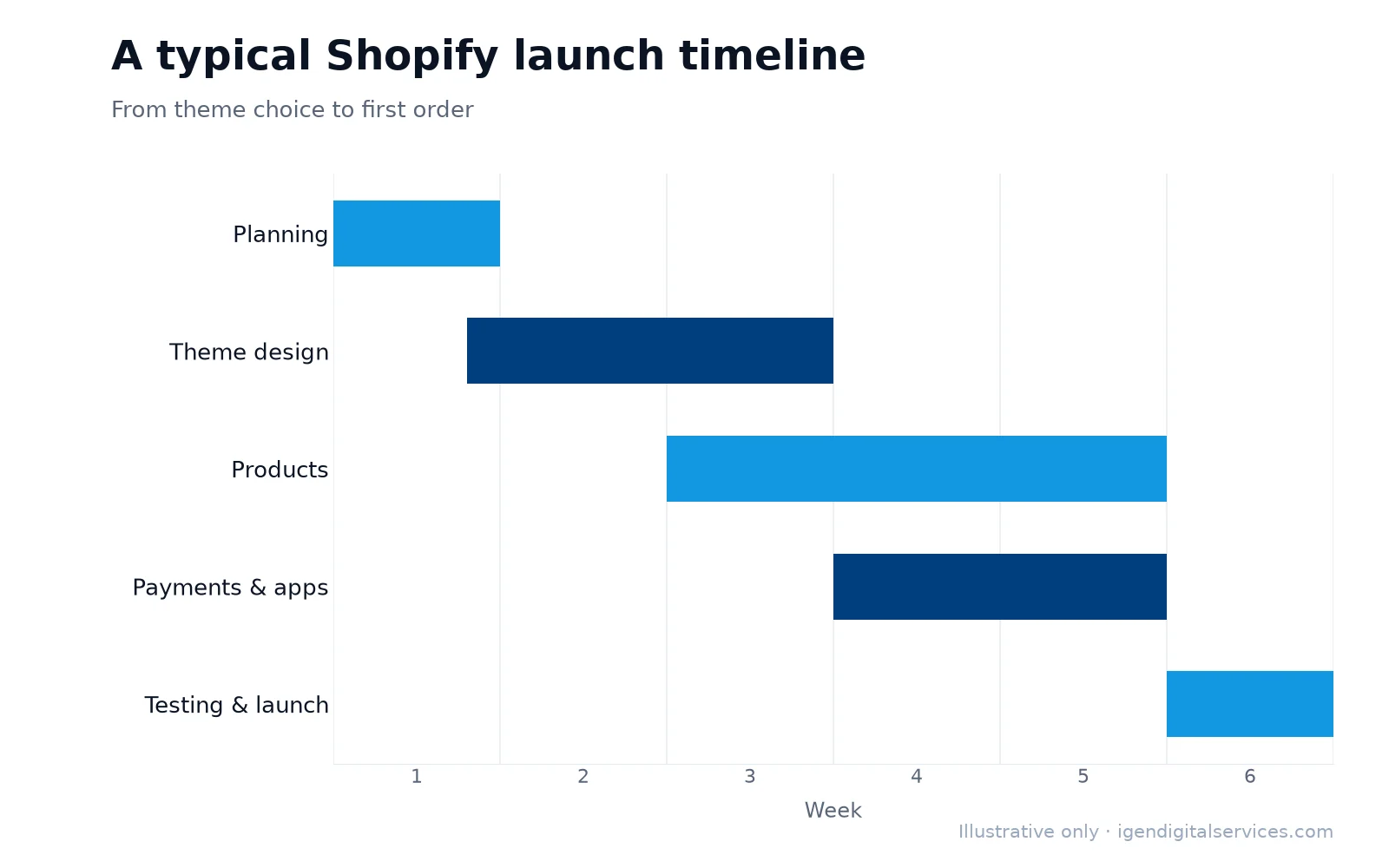
Our Shopify website development process
- Discovery — brand, products, audience, competitors and must-have features.
- Store plan — collections, navigation, pages and apps agreed in writing.
- Design — homepage, collection and product page designs for mobile and desktop.
- Build — theme customisation, Shopify store setup, apps and integrations.
- Content — products, descriptions, images, policies and SEO settings.
- Test — orders, payments, shipping, taxes and emails checked end to end.
- Launch — go-live, analytics, Meta pixel and Google tracking.
- Grow — training, then marketing support to bring your first customers.

Choosing a Shopify agency in India
Look for a Shopify agency in India that shows live stores you can test on your phone, explains platform and app costs honestly, keeps the store and all accounts in your name, sets up tracking and SEO properly, and supports you after launch. Ask how they handle Indian payments, cash on delivery and GST — the details that decide whether a store works smoothly here. The best Shopify website development company in India for you is the one that understands both the platform and your market.
Launch marketing for new Shopify stores
The first weeks after launch set the tone for the store. We usually recommend a simple launch plan: tell existing customers and followers with an email and WhatsApp announcement, run a small Meta Ads catalogue campaign to reach new shoppers, start Google Shopping for people searching your products, and invite early buyers to leave reviews. A launch offer can help, but clear product photos, honest descriptions and fast delivery matter more for repeat orders. Every channel is tracked in your Shopify analytics and ad accounts, so you can see which one brings sales and scale it.
Support and maintenance
Shopify manages the platform, but your store still needs care: seasonal banners and collections, new products, app reviews and removals, theme updates and regular speed checks. Our maintenance plans cover these tasks with a clear response time, so your team can focus on selling.
Growing after launch
Launch is the start, not the finish. Most Shopify stores grow through a mix of Meta Ads with catalogue campaigns, Google Shopping, influencer partnerships, email and WhatsApp automations, and steady SEO. Because we handle Shopify website design and marketing together, your store is built with tracking and growth in mind from the first day.
If you would like expert help, explore our Shopify website design or request a quote for your business.
Key takeaways
- Shopify website design turns a reliable hosted platform into a store that reflects your brand and sells.
- In India, stores use third-party gateways such as Razorpay or PayU, and often cash on delivery.
- Choose between Shopify and WooCommerce based on your team, budget and need for control.
- Mobile speed, strong product pages, trust signals and abandoned-cart recovery drive sales.
Frequently asked questions
How long does it take to build a Shopify store?
Can you migrate my store to Shopify?
Which payment gateways work with Shopify in India?
Do I need paid Shopify apps?
Can you design a custom Shopify theme?
Will I be able to manage the Shopify store myself?
Do you offer Shopify website development for small brands?
What is included in Shopify store setup?
Can you connect Shopify with Amazon and Flipkart?
Is Shopify website design good for SEO?
Want expert help with this?
See what our Shopify website design include, or get a free proposal for your business.

Digital Marketing Consultant and Certified Marketing Analyst from IIT Roorkee, with 10+ years of experience helping businesses improve their digital presence, generate qualified leads and drive measurable growth through SEO, AEO, GEO, Google Ads, performance marketing and analytics.