What is performance marketing, and how is it different from simply running ads? Performance marketing is advertising you judge by what it produces — enquiries, sales, admissions or bookings — rather than by how many people saw it. Done well, it turns ad spend into a predictable growth engine. Done badly, it burns money on clicks that never become customers. This guide explains how performance marketing works, which channels and metrics matter, how budgets are set, what a performance marketing agency does and how to tell whether your campaigns are profitable.
What is performance marketing?
Performance marketing is paid digital advertising managed against measurable business results. Every campaign has a clear goal — a lead, a sale, a call, a booking — and a target cost for that result. Spend is tracked to outcomes, compared across channels and moved toward whatever produces customers most efficiently. It covers search ads, social ads, video ads, shopping and marketplace ads, and the landing pages and tracking that connect them. The idea is simple: every rupee should be accountable.
Performance marketing vs traditional digital marketing
| Brand-led marketing | Performance marketing | |
|---|---|---|
| Main goal | Awareness and recall | Leads, sales and measurable actions |
| Key metrics | Reach, impressions, engagement | Cost per lead, cost per acquisition, ROAS |
| Time frame | Months to years | Days to weeks for feedback |
| Budget decisions | Planned in advance | Adjusted weekly based on results |
The two work best together. Brand-led activity, SEO and content make people familiar with you, which lowers the cost of every paid click later. Performance marketing captures and converts that demand.

The metrics that matter
- Cost per lead (CPL) — ad spend divided by the number of enquiries.
- Cost per acquisition (CPA) — ad spend divided by the number of customers or sales.
- Return on ad spend (ROAS) — revenue from ads divided by ad spend; a ROAS of 4 means ₹4 of sales for every ₹1 spent.
- Conversion rate — the share of visitors or clicks that become leads or sales.
- Lead-to-customer rate — how many leads your team turns into customers.
- Customer lifetime value — what a customer is worth over time, which decides how much you can afford to pay for one.
Clicks, impressions and click-through rate help diagnose problems, but they are not the goal. A performance marketing agency should report the numbers your finance team cares about.
Setting targets from your unit economics
Good performance marketing starts with your numbers, not the platform’s. If an average customer is worth ₹20,000 in profit and your team converts one in ten leads, you can afford to pay up to ₹2,000 per lead before breaking even. That calculation sets the target for every campaign. We work through it with you at the start — average order value, margins, repeat purchases and sales conversion rates — so targets are realistic and profitable rather than arbitrary.
Channels we manage
| Channel | Best for |
|---|---|
| Google Ads — Search, Performance Max, Shopping | Capturing people actively searching for what you sell |
| YouTube ads | Demonstrations, education and building demand at scale |
| Meta ads — Facebook and Instagram | Creating demand, lead ads, WhatsApp conversations, ecommerce |
| LinkedIn ads | B2B decision-makers, recruitment and professional services |
| Amazon PPC | Product brands selling on Amazon |
| Retargeting across channels | Bringing back visitors who did not convert the first time |
We choose channels based on where your buyers are and what the numbers show, not on which platform is easiest to spend on.
Tracking and attribution
Performance marketing is only as good as its tracking. We set up conversion tracking for forms, calls, WhatsApp chats and purchases, connect Google Analytics, the Meta Pixel and Conversions API, and, where possible, import offline results such as closed deals or admissions back into the ad platforms. Google explains the basics in its guide to conversion tracking. With accurate tracking, each platform’s automated bidding learns to find the right people, and your reports show which channels really produce customers.

Landing pages and conversion rate
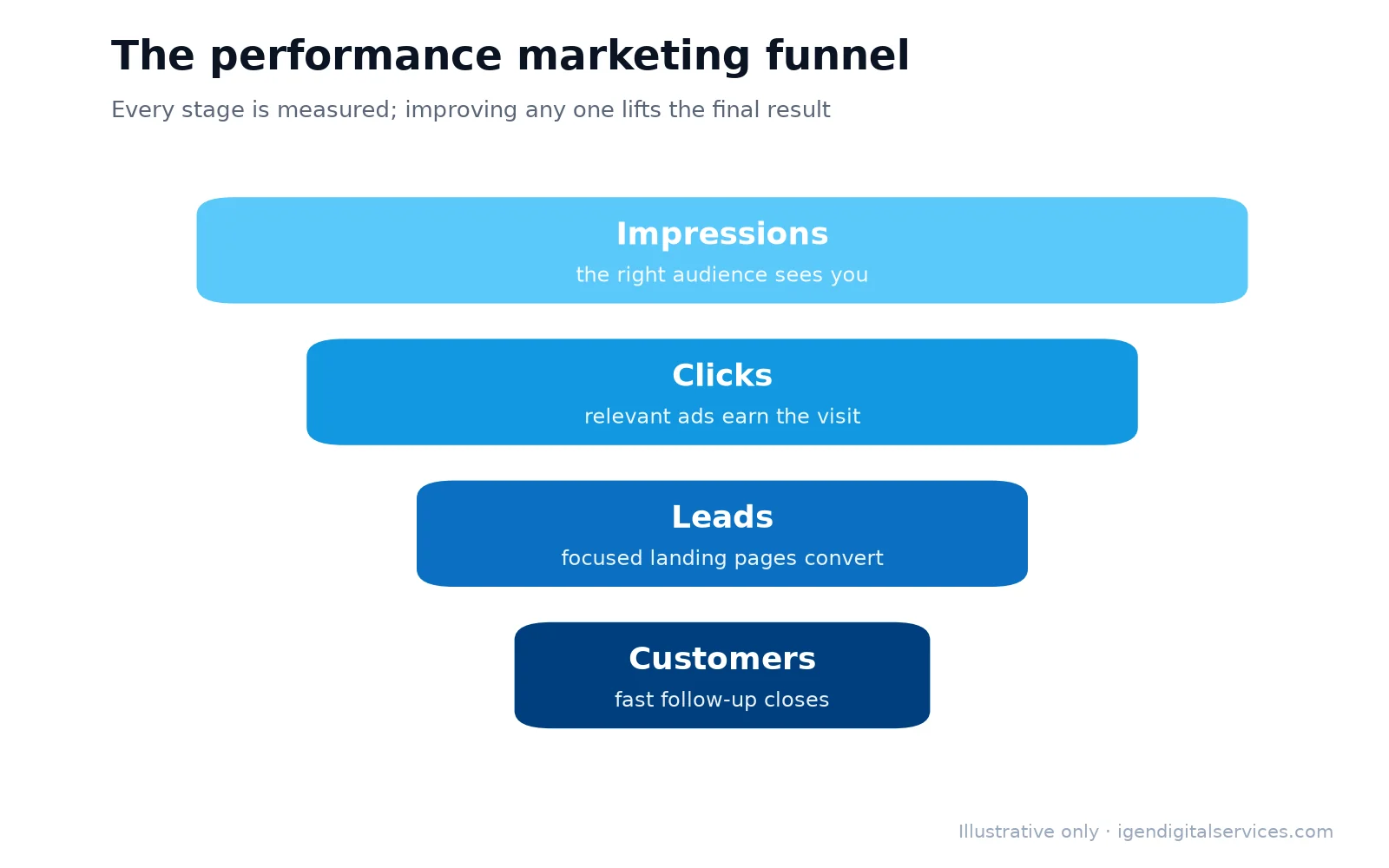
Sending paid traffic to a slow, confusing page wastes budget. Effective landing pages load quickly on mobile, match the promise in the ad, focus on one offer, show proof such as results and reviews, and make the next step easy — a short form, a call button or a WhatsApp link. Small improvements in conversion rate have a large effect on cost per lead, so we test headlines, offers and forms continuously alongside the ads themselves.
Creative testing
On most platforms, creative quality now matters more than targeting settings. We produce and test new ad variations every month — different headlines, images, videos, offers and angles — and keep the ones that perform. Fresh creatives prevent ad fatigue, where results decline as the same people see the same ad repeatedly.
Automated bidding and how to feed it
Google and Meta now rely heavily on automated bidding — strategies such as Maximise Conversions, Target CPA and Target ROAS, where the platform sets bids in real time for each auction. These systems are powerful, but they only optimise for what you tell them to. If a form fill from a student and a form fill from a spam bot are counted the same, the system will happily find more spam. That is why we define conversions carefully, assign values where possible, exclude low-quality actions and import real outcomes, so automation works toward customers rather than numbers.
Seasonality and timing
Demand rises and falls through the year. Admissions, festivals, wedding seasons, year-end budgets and sale events all change how many people search and how much each click costs. We plan budgets around these peaks, build campaigns and creatives before demand arrives, and use quieter months to test new ideas cheaply. Looking at results by week and season, not just month to month, prevents knee-jerk decisions based on normal seasonal swings.
Working with your sales team
The best campaigns can be undone by slow follow-up. We agree how leads reach your team — email, a shared sheet, a CRM or WhatsApp — and how quickly they should be contacted. Regular feedback from your sales team on lead quality lets us adjust targeting, forms and qualification questions. When marketing and sales look at the same numbers, cost per customer usually falls faster than when each works alone.
Budgeting and scaling
We recommend starting with a budget large enough to gather useful data within a few weeks, then scaling in steps as results prove themselves. Scaling too quickly can raise costs, while spreading a small budget across too many channels means none of them gets enough data to optimise. Ad budgets are paid directly to Google, Meta, LinkedIn or Amazon from your own accounts, and our management fee is separate and agreed in advance.
Privacy, consent and data
Tracking must respect privacy laws and platform rules. We collect only the data needed to measure results, use consent banners where required, avoid sending personal information in URLs, and follow each platform’s policies for customer lists and conversion data. With India’s Digital Personal Data Protection Act and stricter browser privacy settings, server-side tracking such as the Conversions API and enhanced conversions helps keep measurement reliable while handling data responsibly.
Reporting you can act on
Monthly reports show spend, results and cost per result for each channel against the targets we agreed, alongside what we changed, what we learned and what we will test next. You can also view live dashboards between reports.
Our performance marketing process
- Discovery — goals, margins, customer value, sales process and past results.
- Audit — existing accounts, tracking, landing pages and competitors.
- Plan — channels, budgets, targets and a testing roadmap.
- Build — tracking, audiences, campaigns, creatives and landing pages.
- Optimise — weekly budget shifts, bid and keyword changes, new creatives.
- Report — monthly results against targets, with clear next steps.
Performance marketing for different businesses
- Education — admission campaigns timed to each intake, with lead quality tracked through to enrolment.
- Healthcare — appointment and enquiry campaigns within platform health-advertising rules.
- Ecommerce and D2C — shopping, catalogue and marketplace campaigns managed for ROAS and profit.
- Real estate — lead campaigns with qualification questions and fast follow-up.
- B2B and manufacturing — search and LinkedIn campaigns aimed at specific industries and roles.
- Local services — call and WhatsApp campaigns targeted around your service area.

Choosing a performance marketing company in Kanpur
When comparing providers, ask how they set targets, what they track, how often they optimise, who owns the ad accounts and how they report. As a performance marketing company in Kanpur working with clients across India and abroad, we keep accounts in your name, share access to live dashboards and agree targets based on your margins. Be cautious of agencies that report only clicks and impressions, or that take a percentage of ad spend without any link to results.
Our performance marketing services include
- Strategy, targets and channel planning based on your unit economics.
- Campaign setup and management on Google, YouTube, Meta, LinkedIn and Amazon.
- Conversion tracking, analytics and offline conversion imports.
- Ad creatives and landing page design and testing.
- Weekly optimisation and monthly reporting against targets.
ROI-driven marketing beyond ads
Paid advertising is the fastest lever, but ROI-driven marketing also looks at what happens around it: how quickly your team responds to leads, how well your website converts, whether past customers are brought back through email and WhatsApp, and whether SEO can reduce dependence on paid clicks over time. We point out these opportunities as we see them, because improving them often raises returns more than increasing ad spend.
Common performance marketing mistakes
- Optimising for cheap clicks or leads instead of customers and revenue.
- Missing or broken conversion tracking, so automated bidding learns the wrong things.
- Changing campaigns too often, before they have enough data.
- Ignoring lead follow-up speed and sales conversion rates.
- Running the same creatives for months until performance fades.
If you would like expert help, explore our performance marketing services or request a quote for your business.
Key takeaways
- Performance marketing is paid advertising managed against measurable results such as leads, sales and ROAS.
- Targets should come from your margins and customer value, not from platform averages.
- Accurate tracking, strong landing pages and continuous creative testing drive results.
- Ad spend is paid directly to the platforms; the management fee is separate and agreed in advance.
Frequently asked questions
What is performance marketing?
What does a performance marketing agency do?
What is a good ROAS?
How much budget do I need for performance marketing?
Is performance marketing only for ecommerce?
How quickly can I see results?
Do you offer performance marketing services outside Kanpur?
Want expert help with this?
See what our performance marketing services include, or get a free proposal for your business.

Digital Marketing Consultant and Certified Marketing Analyst from IIT Roorkee, with 10+ years of experience helping businesses improve their digital presence, generate qualified leads and drive measurable growth through SEO, AEO, GEO, Google Ads, performance marketing and analytics.