What is Amazon Brand Registry, and do you need it before you scale on Amazon? If other sellers can change your product pages, hijack your listings or sell copies of your products, you are not fully in control of your brand online. Amazon Brand Registry gives brand owners that control — and unlocks some of Amazon’s most powerful selling tools. This guide explains what Brand Registry is, what you need to enrol from India, how our Amazon brand registry services work, what it costs and how to use it after approval.
What is Amazon Brand Registry?
Amazon Brand Registry is a free programme for brand owners who hold a trademark. Once enrolled, Amazon treats you as the authority on your brand’s product information, gives you tools to find and report infringement, and unlocks features such as A+ content, Sponsored Brands ads, Brand Stores and brand analytics. For any business that makes or owns its own products, it is one of the most important steps to take before scaling on Amazon.
What Brand Registry gives you
| Benefit | What it means for your business |
|---|---|
| Control of product pages | Your information takes priority when others try to change titles, images or details |
| Infringement reporting | Tools to search for and report counterfeits, copied images and trademark misuse |
| A+ content | Rich, image-based descriptions that lift conversion |
| Sponsored Brands ads | Headline and video ads with your logo at the top of search results |
| Brand Store | A multi-page store for your products on Amazon |
| Brand analytics | Insights into search terms and shopper behaviour for your brand |

Requirements for Amazon Brand Registry in India
To enrol, you generally need:
- A trademark — a registered trademark, or in many cases a pending trademark application, in an eligible country. In India, trademarks are filed with the Trade Marks Registry, which you can search on the official IP India portal.
- The brand name on products or packaging — the trademarked name should appear on the product or its packaging.
- Product and brand details — images of branded products, the categories you sell in and where you manufacture or distribute.
- An Amazon account — a seller or vendor account, or a new Brand Registry account.
The trademark type matters too. A word mark protects the brand name itself; a logo (device) mark protects the design. Amazon’s requirements depend on which one you hold and how it appears on your products.
Trademark for Amazon brand registry: getting it right
Many brands start the process without checking whether their name is available. Before filing, a trademark search helps avoid conflicts with existing marks. Choosing the right class — the category of goods your products fall under — matters, because protection applies to the classes you file in. We work with you and, where needed, with trademark professionals so the application supports your Amazon plans from the start. Once you have an application number, we prepare the Brand Registry application.
Who should enrol
Enrolment makes sense for any business that sells products under its own name: manufacturers launching direct-to-consumer lines, D2C brands, private-label sellers and established companies moving online. It matters most when you plan to invest in advertising and content, because those investments build value in your listings — value that others can take if the listings are not protected. Resellers of other companies’ products cannot enrol those brands; the programme is for the trademark owner or an authorised agent.

Choosing a name you can protect
Protection starts with the name itself. Distinctive, invented or unusual names are easier to register and defend than descriptive ones such as “Best Steel Bottles” or “Pure Cotton Wear”. Before launching a new product line, it is worth searching existing trademarks and marketplace listings for similar names, checking domain and social media availability, and filing in the right class of goods. A little care at this stage prevents expensive rebranding later, when products, packaging and reviews already carry the name.
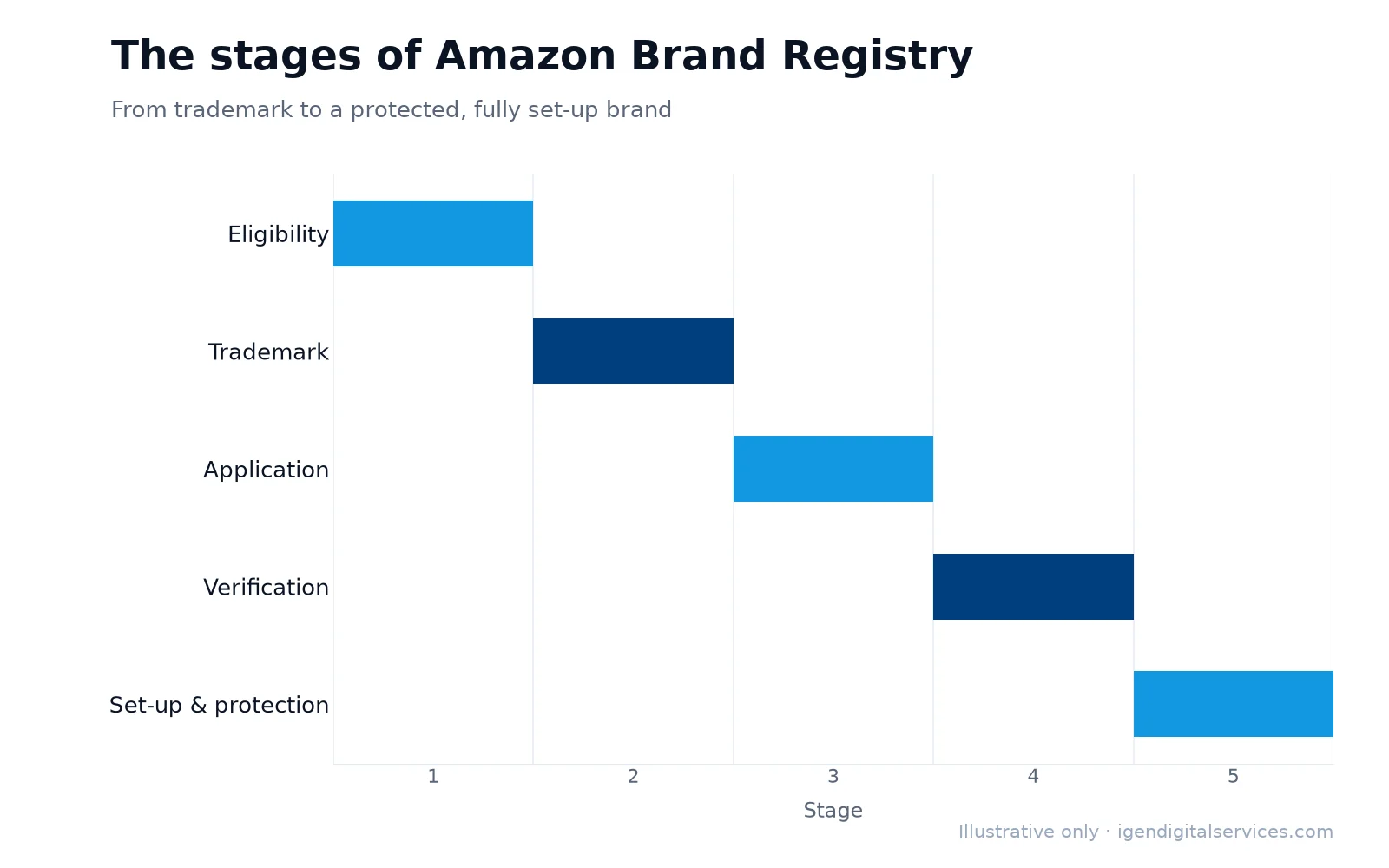
How our Amazon brand registry services work
- Eligibility check — trademark status, class, brand name on products and account details.
- Preparation — product images, packaging photos and brand information collected and checked.
- Application — Brand Registry submitted and verification completed with the trademark contact.
- Approval and setup — brand linked to your listings, user roles assigned and protections configured.
- Growth tools — A+ content, a Brand Store and Sponsored Brands campaigns set up.
- Monitoring — regular checks for hijackers, copied listings and unauthorised changes.
Brand registry cost
Amazon does not charge brand owners to enrol in Brand Registry. The costs involved are the government fees and any professional fees for trademark filing, and our fee for preparing the application, setting up the brand and ongoing protection. We quote these clearly after checking your trademark status, so you know the full cost before starting.
Preparing your products and packaging
Amazon checks that the brand on your application matches what customers receive. Before applying, make sure the trademarked name appears permanently on the product or its packaging — printed, stitched, engraved or on a label — rather than on a removable sticker. Take clear photos of branded products and packaging from several angles, and check that the brand name in your listings matches the trademark exactly, including spelling and spacing. Small mismatches are one of the most common reasons for delays, and they are easy to fix in advance.
Managing user roles and access
Once approved, the brand account can have several users with different permissions — for example, an owner, a marketing agency and an internal catalogue manager. Setting clear roles keeps control with the business owner while allowing partners to do their work. We recommend reviewing access every few months and removing users who no longer need it, especially after staff or agency changes.
Building value on a protected foundation
With the listings secure, investment in content, reviews and advertising builds lasting value for the business. Consistent product information across every listing, a well-designed store, strong images and steady review growth make your products easier to find and trust. Over time, customers begin searching for your brand by name — the clearest sign that your marketplace presence has become a brand rather than a set of products.
Protecting your brand after enrolment
Enrolment is the start of brand protection, not the end. Common threats include hijackers who add themselves to your listings and sell counterfeit or lower-quality versions, sellers who copy your images and content, and unauthorised changes to your product pages. We monitor your listings, use Amazon’s reporting tools to act against infringement, keep your product information correct, and work with you on authorised distribution so only approved sellers offer your products.
Dealing with hijackers step by step
When an unauthorised seller appears on your product page, speed matters, because every sale they take can come with a poor customer experience that damages your reviews. Our process is to confirm the seller is unauthorised, test-buy where appropriate to document counterfeit or misrepresented products, file a report with evidence through Amazon’s reporting tools, and follow up until the issue is resolved. At the same time, we check the product page for unauthorised edits and restore the correct information. Keeping records of every case builds a stronger history for future reports.
Authorised distribution and price stability
Many listing problems begin offline, when stock sold to distributors or wholesalers reaches unauthorised online sellers. Clear distribution agreements, limited authorised sellers, and consistent minimum advertised pricing help keep your marketplace channel clean. We help you map who sells your products online, identify unexpected sellers and align your offline and online distribution, so your own listings keep the sales and the price stays healthy.
Protection beyond Amazon
Your brand also needs protecting on Flipkart and other marketplaces, on social media and in search results. Flipkart has its own process for brand approval and reporting listing issues, social platforms have tools for reporting impersonation and counterfeit ads, and a consistent official website makes it easier for customers to recognise the real brand. We monitor the main channels where your products are sold and discussed, and act quickly when copies or fake accounts appear.
Common reasons applications are delayed
- The brand name on products or packaging does not exactly match the trademark.
- The trademark was filed in a different name than the one applying.
- The trademark covers different goods or classes than the products being sold.
- Product images do not clearly show the brand on the item or packaging.
- The verification code sent to the trademark contact is not received or passed on in time.
Checking these points before submitting avoids most delays and repeated applications.
Working with international marketplaces
If you plan to sell on Amazon in other countries — for example the UAE, the UK or the USA — you will usually need trademark protection in those regions as well, because enrolment is linked to the countries where the trademark is recognised. Planning this early saves time when you expand, and we can help you prepare listings and content for each marketplace.
Using Brand Registry to grow sales
Brand Registry also opens tools that directly increase sales:
- A+ content to explain products visually and cross-sell your range — see our Amazon listing and A+ content service.
- Sponsored Brands ads that put your logo and several products at the top of search results, managed through our Amazon PPC service.
- A Brand Store that works as your own shop inside Amazon, ideal for social media and advertising traffic.
- Brand analytics to understand which searches lead to your products and your competitors’.
If you would like expert help, explore our Amazon brand registry services or request a quote for your business.
Key takeaways
- Amazon Brand Registry is free for trademark owners and protects your listings from hijackers and copycats.
- You need a registered or eligible pending trademark and your brand name on products or packaging.
- Brand Registry unlocks A+ content, Sponsored Brands, Brand Stores and brand analytics.
- Ongoing monitoring keeps protection effective after enrolment.
Frequently asked questions
What is Amazon Brand Registry?
Can I get Amazon Brand Registry with a pending trademark in India?
How much does Amazon Brand Registry cost?
How long does Amazon Brand Registry approval take?
Does Brand Registry stop other sellers from selling my products?
Do I need Brand Registry to sell on Amazon?
Can a reseller enrol a brand it does not own?
What should I do if someone is selling fake versions of my product?
Can you manage our brand account after approval?
Is my brand protected on Flipkart once enrolled on Amazon?
Do I need a logo trademark or a word trademark?
Want expert help with this?
See what our Amazon brand registry services include, or get a free proposal for your business.

Digital Marketing Consultant and Certified Marketing Analyst from IIT Roorkee, with 10+ years of experience helping businesses improve their digital presence, generate qualified leads and drive measurable growth through SEO, AEO, GEO, Google Ads, performance marketing and analytics.