What is marketplace account management, and why do growing sellers hand it to a dedicated team? Selling on Amazon and Flipkart is not a one-time setup. Listings need updating, prices need watching, stock must stay in sync, account health must stay green, and ads need daily attention. This guide explains what marketplace account management covers, what an Amazon account manager actually does, how Flipkart account management differs, what it costs and how to choose the right partner.
What is marketplace account management?
Marketplace account management is the ongoing work of running your seller accounts on platforms such as Amazon, Flipkart, Meesho, Myntra and JioMart. It covers everything from creating and optimising listings to managing pricing, inventory, orders, returns, customer questions, account health, advertising and reporting. For growing brands, a dedicated team handling these tasks means fewer mistakes, faster growth and more time to focus on products and operations.
What does an Amazon account manager do?
An Amazon account manager looks after your Seller Central account day to day. Typical responsibilities include:
- Listings — creating new products, fixing listing errors and keeping titles, bullets, images and A+ content optimised.
- Pricing — monitoring competitors and the Buy Box, and adjusting prices within your agreed limits.
- Inventory — tracking stock levels, planning replenishment and managing FBA shipments.
- Account health — watching order defect rate, late shipments, cancellations and policy warnings.
- Customer experience — answering buyer messages, handling returns and requesting reviews the approved way.
- Advertising — running and optimising Amazon PPC campaigns.
- Reimbursements — identifying lost or damaged FBA inventory and filing claims.
- Reporting — sales, profit, advertising and account health every month.
Our Amazon account management services cover all of these, so nothing important is missed.

Account health: the numbers that protect your business
Amazon measures every seller on a set of performance targets. Falling below them can lead to warnings, lost Buy Box eligibility or even account suspension.
| Metric | Amazon’s target | What it measures |
|---|---|---|
| Order defect rate | Under 1% | Negative feedback, A-to-z claims and chargebacks |
| Pre-fulfilment cancel rate | Under 2.5% | Orders cancelled by the seller before shipping |
| Late shipment rate | Under 4% | Orders shipped after the expected date |
| Policy compliance | No open violations | Listing, product and intellectual property issues |
We check these daily and act early — fixing listing issues, responding to claims and working with your warehouse team on dispatch times — because prevention is far easier than reinstatement. Amazon explains selling policies and programmes on its Amazon seller site.
Flipkart account management services
Flipkart works differently from Amazon in several ways, from listing formats and category rules to its advertising tools and fulfilment options. Our Flipkart account management services cover catalogue creation and optimisation in Flipkart Seller Hub, pricing and offers for big sale events, order and returns management, seller ratings and customer feedback, Flipkart Ads, and eligibility for programmes such as Flipkart Assured. Flipkart’s seller portal is where these settings live, and we manage it alongside your Amazon account so pricing and stock stay consistent across both.
Fulfilment options: FBA, Easy Ship and self-ship
| Option | How it works | Best for |
|---|---|---|
| Fulfilled by Amazon (FBA) | You send stock to Amazon’s warehouses; Amazon packs, ships and handles returns | Fast delivery, Prime eligibility, lower workload |
| Easy Ship | You pack; Amazon’s logistics partners pick up and deliver | Sellers who want control of stock with Amazon delivery |
| Self-ship | You pack and ship with your own courier | Bulky, fragile or specialised products |
The right choice depends on your products, margins and volumes. We help you compare costs and delivery speed, and many brands use a mix — FBA for fast movers and Easy Ship or self-ship for the rest.
Winning the Buy Box
When several sellers offer the same product, one of them wins the Buy Box — the “Add to Cart” button most shoppers use. Amazon considers price, delivery speed, stock availability and seller performance. For brand owners, the priority is protecting listings from unauthorised sellers through brand registry; for resellers, it is competitive pricing, fast fulfilment and excellent account health. We monitor Buy Box share and react quickly when it drops.

Selling on multiple marketplaces
Most growing brands sell on more than one marketplace. Doing that well needs consistent product information, synced inventory to avoid overselling, pricing that respects each platform’s fees, and separate strategies for each audience. We manage Amazon, Flipkart and other marketplaces together, and connect them with your own online store where you have one, so stock and pricing stay accurate everywhere.
Listings that rank and convert
On marketplaces, the listing is your shop window and salesperson in one. We research the words shoppers type, then write titles that lead with what matters most, bullet points that answer the questions buyers ask, and backend search terms that capture variations without stuffing. Images follow each platform’s rules — a clean white-background main image, then close-ups, sizes, lifestyle shots and infographics. For brand owners, A+ content adds rich comparison charts and brand stories that lift conversion. Better listings improve both organic ranking and advertising efficiency, which is why listing work comes before scaling ads.
Reviews and ratings
Ratings strongly influence whether shoppers buy and whether marketplaces rank your products. We use only approved methods: Amazon’s “Request a Review” feature, product inserts that follow the rules, excellent packaging and fast responses to problems. Negative reviews are analysed for patterns — sizing, quality, damage in transit — and fed back to your team, because fixing the cause is the best way to lift ratings. We never buy reviews or offer incentives for positive ones; both break marketplace policies and put your account at risk.
Planning for sale events
Events such as Prime Day, the Great Indian Festival, the Big Billion Days and festive sales can bring a large share of the year’s sales in a few days. Preparation starts weeks earlier: confirming stock and warehouse capacity, submitting deals and coupons on time, updating listings and images, raising advertising budgets on proven products and preparing customer service for higher volumes. After the event, we review what sold, what ran out and what to change next time.
Returns and reimbursements
Returns are part of selling online, but they should not quietly erode your margins. We track return reasons by product, flag unusually high rates and work with you on fixes such as clearer size charts or better packaging. For FBA sellers, lost, damaged or incorrectly refunded inventory is eligible for reimbursement under Amazon’s policies; we review inventory reports and file claims so you recover what you are owed.
Launching new products on marketplaces
A new product starts with no reviews and no sales history. A good launch combines a fully optimised listing, competitive launch pricing, advertising to build early sales, and a review request process from the first orders. We track the launch week by week — impressions, clicks, conversion rate and rank — and adjust quickly, so new products gain traction instead of getting lost in the catalogue.
How much does marketplace account management cost?
The cost depends on the number of marketplaces, the size of your catalogue, order volumes, whether advertising is included, and how much listing and design work is needed. Marketplace fees, advertising budgets and fulfilment charges are paid directly to Amazon or Flipkart from your own accounts. Our fee is quoted as a fixed monthly amount with a clear list of responsibilities, so you know exactly what is covered.
Why brands outsource marketplace account management
Running marketplace accounts well is a full-time job that needs several skills at once: catalogue management, pricing, advertising, logistics, customer service and policy knowledge. Hiring and training a team for all of this is expensive, and one person rarely covers every area. Outsourcing marketplace account management gives you an experienced team, established processes and tools from day one, at a predictable monthly cost. You stay in control of products, pricing limits and approvals, while day-to-day execution is handled for you. Many brands keep a small internal coordinator and let us run the accounts.
What you receive every month
Every month you get a clear report from our Amazon account management services and marketplace team: sales and units by product and marketplace, advertising spend and returns, account health status, Buy Box share for key products, review and rating trends, reimbursements recovered, and the priorities for the coming month. Monthly review calls make sure decisions on pricing, new launches and sale events are made together.

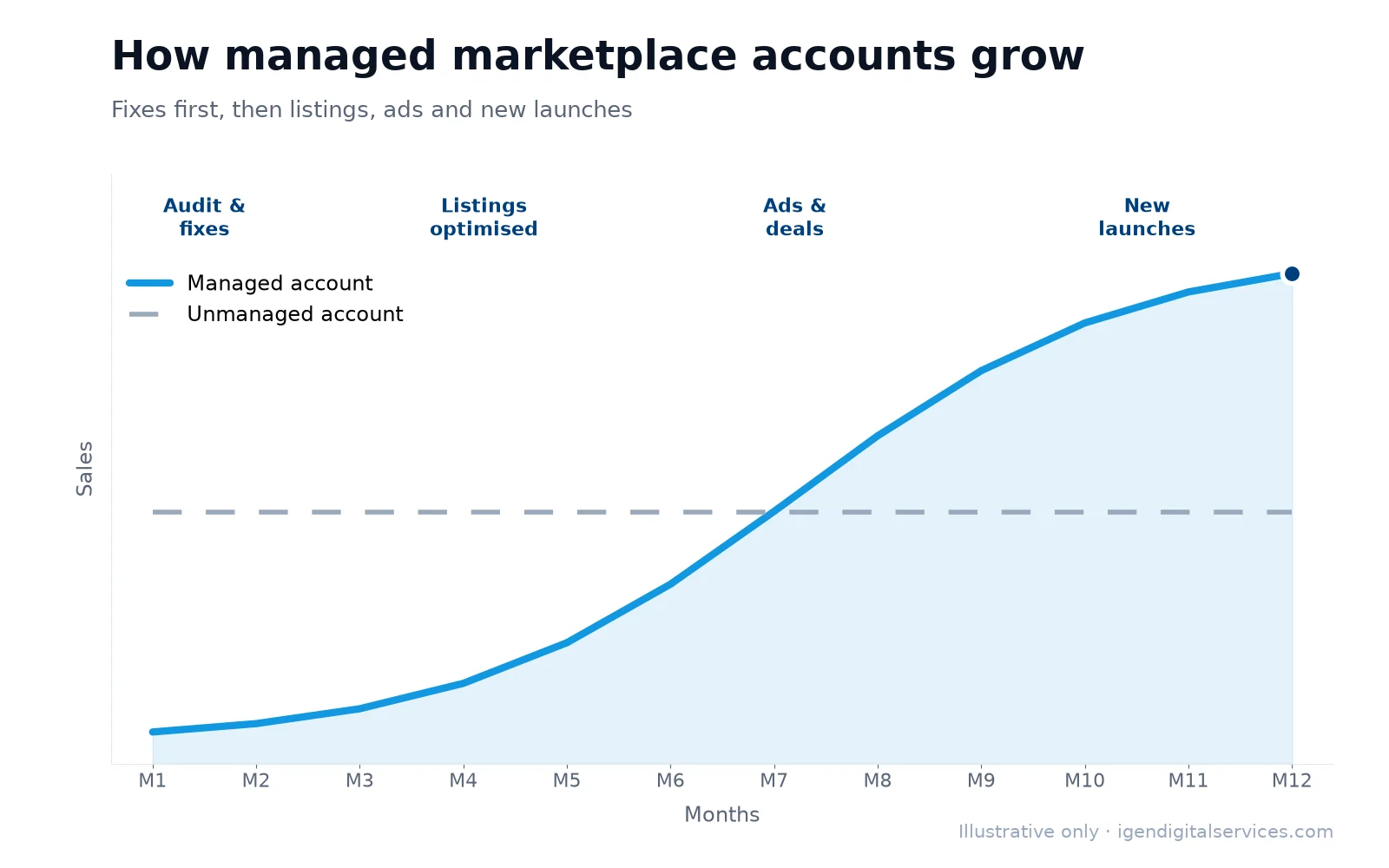
Our marketplace account management process
- Audit — account health, listings, pricing, stock, ads and reviews checked end to end.
- Fix — listing errors, suppressed products, account warnings and quick wins in the first weeks.
- Optimise — keywords, content, images, A+ content and pricing strategy.
- Grow — advertising, deals, sale-event planning and new product launches.
- Report — monthly sales, profit, ad performance and account health, with next steps.
Pricing strategy on marketplaces
Pricing on marketplaces has to cover more than your product cost: referral fees, closing fees, shipping or fulfilment charges, advertising, returns and taxes all come out of each sale. We build a simple profit model for every product so you can see the true margin at different price points, then set pricing rules — a floor you never go below and a target you aim for. During sale events, discounts are planned against that model, so a busy weekend does not turn into a loss.
Common marketplace mistakes
- Letting listings go out of stock, which hurts rankings for weeks afterwards.
- Ignoring account health warnings until they become suspensions.
- Competing on price alone and eroding margins.
- Poor product images and thin descriptions that lower conversion rates.
- Not claiming reimbursements for lost or damaged FBA stock.
- Running ads without tracking profit per product.
Who we work with
We manage marketplace accounts for manufacturers, D2C brands and sellers across India — including businesses from Kanpur’s leather, textile and packaging sectors — in categories such as fashion, home and kitchen, beauty, food, electronics accessories and handicrafts. Whether you are launching your first products or managing hundreds of listings, the process is the same: protect the account, improve the listings, then grow with advertising.
If you would like expert help, explore our marketplace account management or request a quote for your business.
Key takeaways
- Marketplace account management covers listings, pricing, inventory, orders, account health, ads and reporting.
- An Amazon account manager protects account health and grows sales every day.
- Flipkart account management needs its own strategy for catalogue, pricing, ads and sale events.
- Fees and ad budgets are paid directly to the marketplaces; our management fee is fixed and separate.
Frequently asked questions
What does an Amazon account manager do?
How much do Amazon account management services cost?
Can you manage both Amazon and Flipkart?
Can you help with a suspended Amazon account?
Do I need Brand Registry for marketplace account management?
Should I choose FBA or Easy Ship?
Will I keep full control of my seller accounts?
Which marketplaces do you manage besides Amazon and Flipkart?
What do Flipkart account management services include?
How quickly can you improve an underperforming seller account?
Want expert help with this?
See what our marketplace account management include, or get a free proposal for your business.

Digital Marketing Consultant and Certified Marketing Analyst from IIT Roorkee, with 10+ years of experience helping businesses improve their digital presence, generate qualified leads and drive measurable growth through SEO, AEO, GEO, Google Ads, performance marketing and analytics.