This email marketing guide shows how to turn a customer list into steady repeat business. Email is the one marketing channel you fully own. Social platforms change their rules and ad costs rise, but your email list stays yours. This guide explains how email marketing works today, what professional email marketing services include, how automation brings customers back, what it costs in India and how to measure success.
Why email marketing still works
Email marketing lets you speak directly to people who have already shown interest in your business — past customers, enquiries and subscribers. Because you are not paying for every view, a well-run email programme is one of the most cost-effective ways to drive repeat sales, bookings and referrals.
It works best for businesses with repeat customers or longer decisions: online stores, clinics, education providers, B2B suppliers, restaurants, hotels and professional services. For these businesses, a steady rhythm of useful emails keeps you remembered when the customer is ready to buy again.
What our email marketing services include
| Component | What we do |
|---|---|
| Strategy | Goals, audience segments, content themes and a sending calendar |
| List growth | Sign-up forms, pop-ups, lead magnets and checkout opt-ins |
| Design | Mobile-friendly, branded email templates |
| Copywriting | Subject lines, newsletters, offers and automated sequences |
| Automation | Welcome, abandoned cart, re-engagement and post-purchase journeys |
| Deliverability | Domain authentication, list cleaning and sending best practice |
| Reporting | Opens, clicks, conversions and revenue from every campaign |
As an email marketing company in Kanpur serving clients across India, we handle the full process — from the first sign-up form to the monthly report.
Newsletters vs automated emails
There are two kinds of emails every business should send. Newsletters are regular updates sent to your whole list or a segment: tips, new products, offers, news and stories. Automated emails are triggered by what a person does — signing up, abandoning a cart, making a purchase or going quiet for a few months.
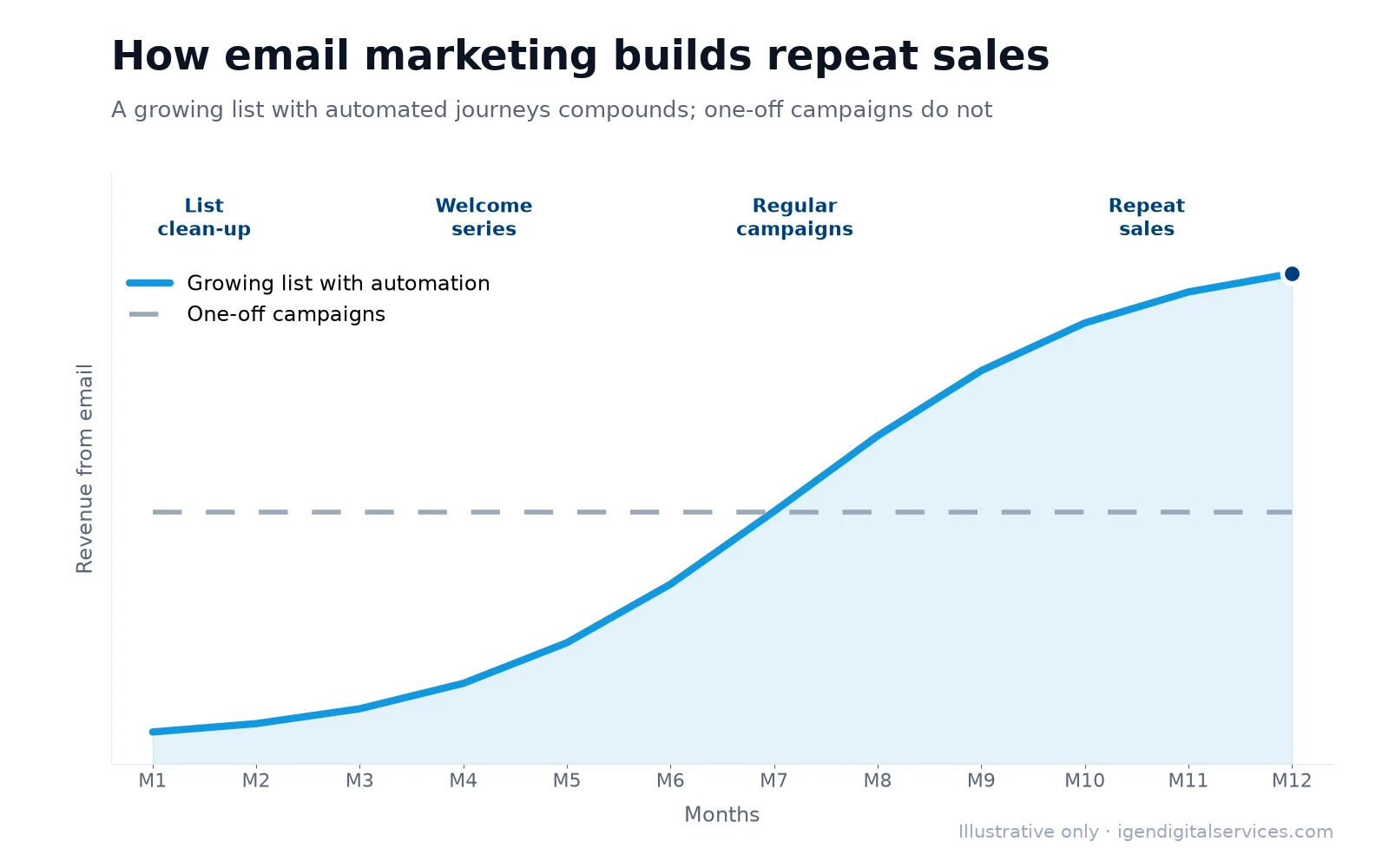
Newsletters keep your brand visible; automations quietly bring in revenue in the background. Most businesses start with a monthly newsletter and a simple welcome sequence, then add more automations as the list grows.
Email automations that bring customers back
- Welcome series — introduce your business, set expectations and share your best offer or resources.
- Abandoned cart — remind online shoppers of the products they left behind.
- Post-purchase — thank customers, share care or usage tips and ask for a review.
- Win-back — reach customers who have not bought in a while with a reason to return.
- Appointment and renewal reminders — for clinics, services and subscriptions.
- Lead nurturing — for B2B and high-value services, a sequence that answers common questions and builds trust before a sales call.
Each automation is written once and keeps working every day, which is why email marketing services pay back so well over time.
Deliverability: making sure emails reach the inbox
Great emails are useless if they land in spam. Since 2024, Google and Yahoo require bulk senders to authenticate their domain, make unsubscribing easy and keep spam complaints low. Google’s email sender guidelines explain the rules. We set up SPF, DKIM and DMARC records for your domain, warm up new sending domains gradually, remove invalid and inactive addresses, and never buy or rent lists. These steps protect your sender reputation and keep open rates healthy.
Email marketing services in India: what affects the cost
The cost of email marketing depends on the size of your list, how often you send, how much design and writing is needed, and the email platform you use. Platforms usually charge by the number of contacts or emails sent, and that fee is paid directly to the platform. Our fee covers strategy, templates, writing, automation setup and reporting, quoted as a fixed monthly amount. For many small businesses, a monthly newsletter plus a welcome sequence is an affordable starting point.
Email marketing for small business
Small businesses often think email is only for big brands. In fact, a small, engaged list of a few hundred customers can bring regular repeat business. Start simply:
- Collect emails with permission at checkout, on your website and at the counter.
- Send one genuinely useful email a month — tips, a seasonal offer or a customer story.
- Set up a welcome email and a thank-you email after purchase.
- Keep the design simple and mobile-friendly; most emails are opened on phones.
- Measure clicks and sales, not just opens.
Building your email list the right way
A list built with permission is worth far more than a large list of strangers. The best places to collect email addresses are:
- Your website — a short sign-up form offering something useful, such as a guide, a checklist or early access to offers.
- Checkout and booking forms — a clear opt-in box for updates.
- In person — a QR code at the counter, reception or event stand.
- Social media and ads — lead forms that invite people to subscribe for tips or offers.
- Existing customers — a one-time message inviting them to join, with a reason to say yes.
Always tell people what they will receive and how often, and make it easy to unsubscribe. Honest expectations keep engagement high and complaints low.
Subject lines that get opened
The subject line decides whether an email is read. Good subject lines are short, specific and honest about what is inside. Useful patterns include a clear benefit (“5 ways to cut your electricity bill this summer”), a question your reader cares about, a deadline for a genuine offer, or a personal note from a real person at your business. Avoid all-capital letters, excessive punctuation and misleading hooks — they hurt trust and can trigger spam filters. We test subject lines on every campaign and keep what works for your audience.
Email marketing for different industries
| Industry | Emails that work well |
|---|---|
| Online stores | Abandoned cart, new arrivals, restock alerts, post-purchase reviews |
| Clinics and hospitals | Appointment reminders, health tips, check-up campaigns |
| Colleges and coaching | Admission updates, deadline reminders, results and success stories |
| B2B and manufacturers | Product updates, case studies, trade-show invitations, quote follow-ups |
| Restaurants and hotels | Festival menus, special events, loyalty offers, booking reminders |
| Professional services | Monthly insights, regulatory updates, client stories |
Our email marketing process
- Audit — we review your current list, platform, past campaigns and deliverability.
- Plan — segments, automations and a three-month content calendar agreed with you.
- Build — templates, sign-up forms and automated journeys set up and tested.
- Send and optimise — campaigns go out on schedule, with testing of subject lines, timing and content.
- Report — a monthly summary of results and the next month’s plan.
What to write about
- Education — how-to guides, tips and answers to common questions.
- Offers — seasonal promotions, bundles and early access for subscribers.
- Proof — customer stories, reviews and results.
- News — new products, services, branches or team members.
- Behind the scenes — how you work, source or make things.
A good rule is that most emails should help the reader, with offers mixed in, not the other way around.
Personalisation and segmentation
Sending the same email to everyone is the fastest way to lose attention. Segmentation means grouping subscribers by what they care about — the products they bought, the city they live in, the course they enquired about or how recently they engaged — and sending each group relevant content. Personalisation goes further, using a first name, a recommended product or a reminder based on past behaviour. Even simple segments, such as new subscribers, active customers and inactive customers, noticeably improve clicks and sales while reducing unsubscribes. We set up segments from the start, so your email marketing grows more relevant as the list grows.
Email marketing and the law
In India, marketing messages should go only to people who have agreed to receive them, and every email must make it easy to opt out. The Digital Personal Data Protection Act also expects businesses to collect personal data for a clear purpose and protect it. In practice, this means clear consent at sign-up, a visible unsubscribe link, honest sender details and secure handling of your list. We build these into every campaign, and we follow the rules of the countries you email if you have customers abroad.
Common email mistakes to avoid
- Sending only promotions, with no useful content.
- Emailing the whole list the same message every time.
- Ignoring mobile layout, when most emails are read on phones.
- Letting inactive addresses pile up, which hurts deliverability.
- Measuring success by opens alone instead of clicks and sales.
Measuring email marketing results
| Metric | What it tells you |
|---|---|
| Delivery rate | Whether emails reach inboxes or bounce |
| Open rate | How well subject lines and sender name work (less reliable with privacy features) |
| Click rate | Whether the content is interesting enough to act on |
| Conversion rate | How many clicks turn into enquiries or sales |
| Revenue per email | The value each campaign brings in |
| Unsubscribe and spam rate | Whether you are sending too often or to the wrong people |
We report these every month with clear recommendations, so each campaign improves on the last.
Email, WhatsApp and SMS together
Email works best alongside other direct channels. WhatsApp is ideal for quick updates and conversations, SMS for urgent reminders, and email for richer content, newsletters and receipts. Our mobile marketing service covers WhatsApp and SMS, so all three channels share one plan and never overwhelm your customers.
If you would like expert help, explore our email marketing services or request a quote for your business.
Key takeaways
- Email marketing reaches people who already know you, on a channel you own.
- Combine regular newsletters with automations such as welcome, abandoned cart and win-back emails.
- Authentication, clean lists and easy unsubscribes keep emails out of spam.
- Measure clicks, conversions and revenue, not just open rates.
Email marketing guide: frequently asked questions
What do email marketing services include?
How often should a business send marketing emails?
Is email marketing effective for small businesses in India?
Can I buy an email list to send campaigns?
Which email marketing platform do you use?
How long does it take to see results from email marketing?
Do you write the emails or do we?
Can you connect email marketing to my online store?
What is a good open rate for marketing emails?
Do you offer email marketing for B2B companies?
Want expert help with this?
See what our email marketing services include, or get a free proposal for your business.

Digital Marketing Consultant and Certified Marketing Analyst from IIT Roorkee, with 10+ years of experience helping businesses improve their digital presence, generate qualified leads and drive measurable growth through SEO, AEO, GEO, Google Ads, performance marketing and analytics.