
What are SEO services, and what should you expect when you pay for them? Good SEO is not a mystery or a monthly report full of jargon. This guide explains exactly what professional SEO services include, how local SEO and national SEO differ, the SEO cost in India, how long results take, and how to choose the right SEO company for your business.
What are SEO services?
SEO services are the ongoing work that helps your website appear in Google’s organic results — and now in AI answers — for the searches your customers make. An SEO agency researches those searches, fixes technical problems that stop Google reading your site, improves your pages and content, and earns the authority (links and mentions) that makes Google trust you.
Unlike ads, organic rankings keep bringing visitors without paying per click. That is why SEO is usually the lowest-cost source of enquiries over time, once the foundations are in place.

The four pillars of SEO
Every good SEO plan covers the same four pillars. What changes from business to business is where most of the effort goes.
| Pillar | What it covers | Why it matters |
|---|---|---|
| Technical SEO | Speed, Core Web Vitals, crawling, indexing, schema, mobile fixes | Google must be able to find and understand every page |
| On-page SEO | Titles, meta descriptions, headings, internal links, page copy | Each page targets the right search intent |
| Content | Service pages, guides and blogs built around real questions | Content is what ranks — and what AI tools quote |
| Authority | Relevant links, brand mentions, local citations, digital PR | Signals that other sites trust your business |
Local SEO vs national SEO
If your customers come from one city or area — a clinic, school, showroom or restaurant — you need local SEO: a strong Google Business Profile, reviews, citations and location pages, so you appear in the Google Maps top three.
If you sell across India or abroad — a manufacturer, D2C brand, SaaS company or online store — you need national SEO, targeting product and category keywords with stronger content and authority. Many businesses need both: local SEO for walk-in customers and national SEO for buyers elsewhere. The two work best when they are planned together.

SEO cost in India: how much do SEO services cost?
The SEO cost in India depends on four factors:
- Competition — ranking for “SEO services in Delhi” takes far more work than a niche industrial product.
- Website size and health — a 20-page site with clean code needs less technical work than a 2,000-page store with problems.
- Content volume — how many new pages and articles you need each month.
- Authority building — how many quality links and mentions your market requires.
SEO is priced as a monthly plan because the work continues every month. Ask for a fixed monthly fee with a written list of deliverables, so you always know what you are paying for. If you want to understand your website first, a detailed audit is a sensible first step: ours costs ₹1,999 including taxes for websites under 200 pages, and our free SEO analysis tool checks the basics in seconds.
What a typical SEO plan looks like
| Stage | Months 1–2 | Months 3–6 | Month 6 onwards |
|---|---|---|---|
| Focus | Audit and foundations | Content and authority | Growth and conversion |
| Work | Technical fixes, keyword mapping, on-page optimisation | New pages and articles, link building, local citations | Scaling what ranks, improving conversion rates |
| What you see | Pages indexed correctly, faster site | Rankings and impressions rising | Steady organic leads |
Every plan should include Google Search Console and Google Analytics 4 tracking and a monthly report on rankings, traffic and leads.
How long does SEO take to show results?
Most websites see early movement in 6–12 weeks and meaningful growth in traffic and leads in four to six months. Local SEO usually moves faster. Brand-new websites and highly competitive keywords take longer.
The reason SEO is worth the wait is the way results compound. Paid ads stop when the budget stops; every page that ranks keeps bringing visitors, so the cost of each enquiry tends to fall over time.
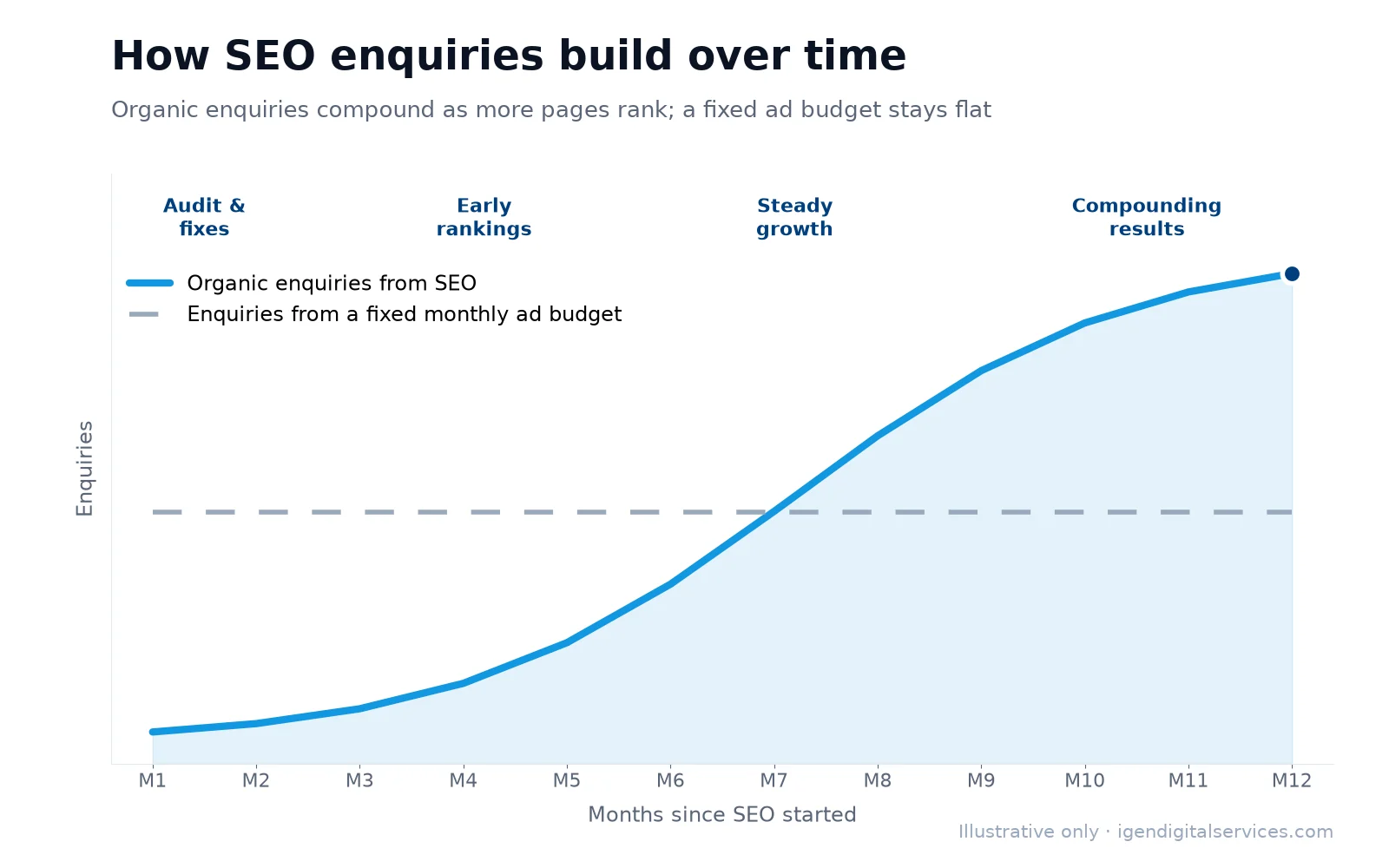
- Months 1–2: audits, tracking and technical fixes; little visible change yet.
- Months 3–4: optimised pages start ranking for easier, specific searches.
- Months 5–6: broader rankings improve and organic enquiries become regular.
- Months 6–12: growth compounds as more pages rank and earn authority.
SEO vs Google Ads: which should you choose?
SEO and Google Ads both put your business in front of people searching on Google, but they work very differently:
| SEO | Google Ads | |
|---|---|---|
| How you pay | Monthly work; no charge per click | Every click is paid for |
| Speed | Builds over months | Enquiries can start within days |
| When it stops | Rankings keep working for a long time | Visibility stops when the budget stops |
| Best for | Lasting, lower-cost enquiries | Fast results, launches and seasonal demand |
| Trust | Many searchers trust organic results | Clearly labelled as sponsored |
Most growing businesses use both: ads for quick, predictable enquiries while SEO builds a long-term source of customers that becomes cheaper over time.
SEO for AI search: GEO and AEO
People increasingly get answers from Google’s AI Overviews, ChatGPT, Gemini and Perplexity before they click a link. Modern SEO includes the work that helps AI tools find, trust and cite your business:
- Answer-first content — clear, direct answers to the questions your customers ask, near the top of each section.
- Structured data — schema markup that describes your business, services and pages to search engines.
- Consistent entity information — the same name, address, services and facts across your website, Google Business Profile and directories.
- Citations and mentions — being listed on the trusted sites and articles AI tools draw from.
Google’s guidance on creating helpful, reliable, people-first content is the foundation of this approach. Our AI SEO services page explains how we apply it.
Common SEO problems and how to fix them
Most websites have the same handful of problems. Fixing them is often the quickest way to lift rankings before any new content is written:
- Pages Google cannot index. Accidental “noindex” tags, blocked resources in robots.txt or broken canonical tags keep good pages out of search.
- Slow mobile pages. Heavy images, too many plugins and render-blocking scripts hurt Core Web Vitals and conversions. Google’s PageSpeed Insights shows how your pages perform on real phones.
- Keyword cannibalisation. Several pages competing for the same search, so none of them ranks well.
- Thin or duplicate service pages. Pages with a few lines of text, or the same text for every city, rarely rank.
- Missing structured data. Without schema, search engines and AI tools have to guess what your business does.
- No internal linking. Important pages that nothing links to are hard for Google to find and value.
- Toxic backlinks. Cheap link packages from the past can hold a site back and need to be cleaned up.
A full audit finds these issues so they can be fixed in order of impact, usually within the first 30–45 days.

How to measure whether SEO is working
Rankings are only one sign of progress. A useful SEO report connects search visibility to business results:
| Metric | What it tells you | Where to find it |
|---|---|---|
| Impressions | How often your pages appear in Google results | Google Search Console |
| Clicks and click-through rate | How many searchers choose your result | Google Search Console |
| Average position | Where your pages rank for the searches that matter | Google Search Console |
| Organic sessions | Visitors arriving from search | Google Analytics 4 |
| Enquiries from organic search | Calls, forms and WhatsApp chats from SEO | GA4 conversions and call tracking |
| Pages indexed | Whether Google can see all your important pages | Search Console page indexing report |
Ask for access to these tools in your own name, so you can check every number yourself at any time. Watch trends over several months rather than daily changes. Rankings move up and down; steady growth in impressions, clicks and enquiries is what shows that SEO services are working.
A simple SEO checklist for your website
Before investing in content or links, make sure these basics are in place. Many can be checked in a few minutes:
- Every important page is indexed — search site:yourdomain.com and check Search Console.
- Each page has a unique title and description that match what people search for.
- One clear H1 per page, with subheadings that answer customer questions.
- Your pages load quickly on mobile — test them with PageSpeed Insights.
- Your business details are consistent — name, address and phone number match everywhere.
- Your Google Business Profile is complete, with categories, services, photos and hours.
- Structured data describes your business, services and FAQs.
- Important pages are linked from your menu and from related pages.
- You can track enquiries, so you know which pages bring customers.
Technical SEO and on-page SEO problems on this list are usually the fastest wins, because fixing them helps pages you already have.
SEO terms explained
SEO comes with its own vocabulary. These are the terms you will see most often in proposals and reports:
- Technical SEO — work on the website itself (speed, indexing, structure, schema) so search engines can crawl and understand it.
- On-page SEO — optimising each page’s titles, headings, content and internal links for the searches it targets.
- Off-page SEO — building trust from outside your site through links, mentions, reviews and citations.
- Local SEO — improving visibility in Google Maps and “near me” results for a city or area.
- Keyword intent — what a searcher actually wants: information, a comparison, or to buy or contact someone now.
- Backlink — a link from another website to yours; relevant links from trusted sites act as recommendations.
- Core Web Vitals — Google’s measures of loading speed, responsiveness and visual stability.
- Schema markup — structured data that tells search engines exactly what your business, services and pages are about.
- Search Console — Google’s free tool that shows how your site performs in search and flags problems.
How to choose an SEO company
When you compare SEO agencies, look for these signs:
- Proof — case studies with real Search Console data, not only screenshots of rankings.
- Transparency — a written list of monthly deliverables and access to your own analytics.
- White-hat methods — no private blog networks or cheap link packages that risk a penalty.
- Business focus — targets based on leads and revenue, not vanity keywords.
- Honesty — nobody can guarantee a #1 ranking, and a good SEO company will tell you so.
- Ownership — your website, content and accounts must stay in your name.
Questions to ask before hiring an SEO agency
A short conversation reveals a lot about how an agency works. Ask:
- What exactly will you do in the first three months? Expect a clear plan, not “we will improve your rankings”.
- Which keywords will you target, and why? Good answers connect keywords to your services and customers.
- How will you build links? Listen for outreach, content and local citations — not bulk packages.
- What will the monthly report show? Look for enquiries and traffic, not just positions.
- Who will work on my website? You should know who does the work and how to reach them.
- What happens if I leave? Your content, accounts and data should stay with you.
What SEO cannot do
SEO is powerful, but it has limits worth knowing. It cannot make a business rank for searches that have nothing to do with what it offers, and it cannot force Google to show a particular result — rankings are always Google’s decision. It is slower than advertising, so it will not rescue a sales target for next week. And it cannot fix a weak offer: if prices, service or reviews are uncompetitive, more visitors will not become more customers. The best results come when SEO supports a business that already serves its customers well.
Can you do SEO yourself?
You can handle the basics yourself — a complete Google Business Profile, clear page titles, useful content and a fast website. Technical fixes, content at scale and safe link building take time and experience, which is why most growing businesses work with an SEO agency once the basics are in place.
If you would like help, see what our SEO services include, or start with a free on-page audit from our team.
Key takeaways
- SEO services cover four pillars: technical SEO, on-page SEO, content and authority.
- Local SEO wins Google Maps; national SEO wins product and category searches — many businesses need both.
- The cost of SEO in India depends on competition, site size, content and links; expect a fixed monthly fee.
- Results usually show in 6–12 weeks and grow over four to six months, then keep compounding.
Frequently asked questions
What is included in SEO packages?
Is SEO worth it for a small business in India?
What is the difference between on-page and off-page SEO?
How should SEO results be reported?
What are SEO services for a small business?
Do reviews and social media affect SEO?
How often should website content be updated for SEO?
Is SEO a one-time job or an ongoing service?
Does SEO work for ecommerce and Shopify stores?
Want expert help with this?
See what our SEO services include, or get a free proposal for your business.

Digital Marketing Consultant and Certified Marketing Analyst from IIT Roorkee, with 10+ years of experience helping businesses improve their digital presence, generate qualified leads and drive measurable growth through SEO, AEO, GEO, Google Ads, performance marketing and analytics.