
This Amazon listing optimisation guide explains how a product page ranks and what makes shoppers buy. On Amazon, shoppers cannot touch, try or ask a salesperson about your product. Your Amazon listing has to do all of that — rank in search, answer questions and convince people to buy. This guide explains how Amazon listing optimisation works, what each part of a listing does, what A+ content is and how it lifts sales, and how our Amazon A+ content services fit into a wider marketplace strategy.
What makes a great Amazon listing?
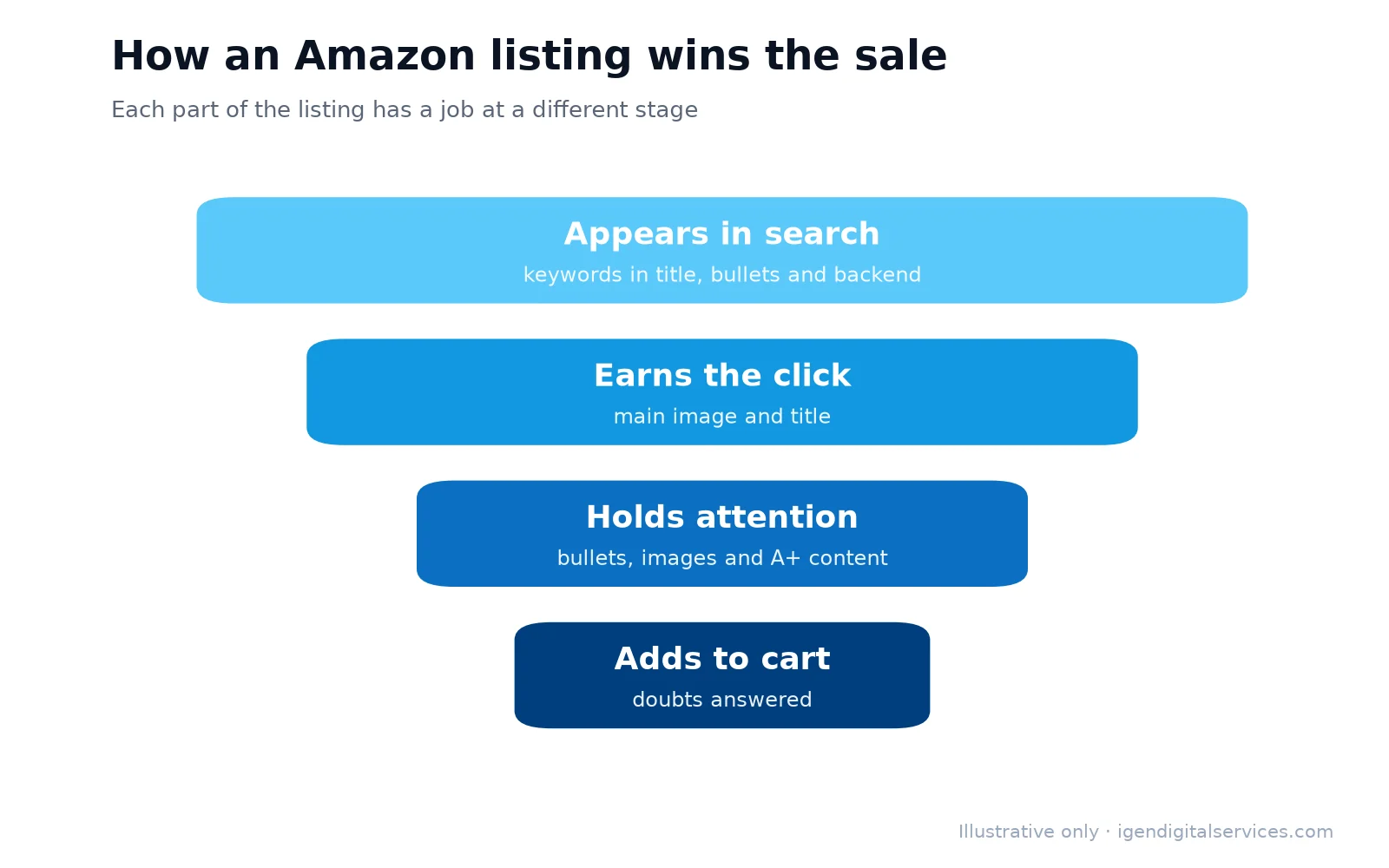
A great Amazon listing does two jobs. First, it helps Amazon’s search engine understand exactly what the product is, so it appears for the right searches. Second, it convinces shoppers — who are comparing several similar products on a phone screen — that yours is the best choice. Both jobs depend on the same elements: the title, images, bullet points, description, backend search terms, A+ content, price, reviews and delivery promise.
The parts of an Amazon listing
| Element | Job | What good looks like |
|---|---|---|
| Title | Ranking and first impression | Brand, product type, key feature, size or quantity — clear, not stuffed |
| Main image | The click | Pure white background, product filling the frame, sharp and zoomable |
| Secondary images | Answering questions | Close-ups, dimensions, in use, what’s in the box, infographics |
| Bullet points | Persuasion | Five benefit-led points that answer buyers’ main questions |
| Description / A+ content | Brand and detail | Rich visuals, comparisons and brand story |
| Backend search terms | Hidden relevance | Synonyms and variations not already in the listing |
| Reviews and ratings | Trust | A steady flow of genuine reviews |

Amazon listing optimisation: our process
- Keyword research — we collect the words shoppers use from Amazon’s search suggestions, competitor listings, your advertising search-term reports and category trends.
- Keyword mapping — primary keywords go in the title, secondary ones in bullets, and remaining variations in backend search terms.
- Copywriting — titles, bullets and descriptions written for shoppers first, within Amazon’s style and character rules for your category.
- Image plan — a brief for each image slot so every image answers a specific question.
- A+ content — modules designed to tell your brand story and compare products.
- Testing and monitoring — we track conversion rate, sessions and rank, and refine the listing over time.
Amazon listing optimisation is never finished; the best listings are updated as reviews, questions and search trends reveal what shoppers care about.
What is A+ content?
A+ content is an enhanced product description section available to brand owners enrolled in Amazon Brand Registry. Instead of plain text, you can use image-rich modules: brand banners, feature images with captions, comparison charts linking your products, and a brand story section. Shoppers scroll to A+ content when they are close to deciding, so it is one of the best places to answer final doubts and cross-sell other products. Premium A+ content, available to eligible brands, adds larger, more interactive modules.
Why A+ content matters
- Higher conversion — clear visuals and comparisons answer questions that text cannot.
- Brand building — a consistent look across all your products makes your brand recognisable.
- Cross-selling — comparison charts guide shoppers to other products in your range.
- Fewer returns — accurate sizes, materials and usage information set the right expectations.
- Mobile-friendly — well-designed modules read clearly on phones, where most shopping happens.
Our Amazon A+ content services cover the module plan, copywriting, image design and upload, following Amazon’s content guidelines.
Main image rules you must follow
Amazon has strict requirements for main images. The background must be pure white, the product should fill most of the frame, and there should be no text, logos, watermarks or props that are not included in the sale. Images should be large enough to allow zoom — Amazon enables zoom for images at least 1,000 pixels on the longest side. Amazon’s seller guidance on sell.amazon.in explains the programme rules. Breaking these rules can suppress a listing, so our product image editing team prepares images that comply while still standing out in search results.

Writing bullet points that sell
Bullet points are where shoppers look for reasons to buy. The strongest bullets start with the benefit in a few capitalised words, then explain the feature that delivers it — for example, “STAYS COLD FOR 24 HOURS — double-wall steel insulation keeps drinks chilled through a full day”. Each bullet should answer one question a buyer is likely to ask: size and fit, material and quality, how to use it, what is included, and warranty or support. We read your reviews and customer questions, and those of competitors, to find the doubts that stop people buying, then answer them directly.
A seven-image plan
| Image slot | Purpose |
|---|---|
| 1. Main image | Clean product on white, filling the frame — wins the click |
| 2. Key benefit | The single most important reason to buy, shown visually |
| 3. Features | Close-ups with short labels for materials and details |
| 4. Size and dimensions | Measurements against a familiar object or person |
| 5. In use | The product in a real setting, with real people where possible |
| 6. What’s in the box | Everything included, so there are no surprises |
| 7. Trust | Certifications, warranty, care instructions or a comparison |
Planning images this way means every slot works, instead of seven similar photos from different angles.
Brand Store: your shop inside Amazon
Brand-registered sellers can also build a Brand Store — a multi-page storefront with its own address on Amazon. It gives shoppers a place to browse your full range without competitors’ products alongside, and it is a good destination for social media, influencer and advertising traffic. We design stores that group products the way customers shop, and keep them updated with new launches and seasonal collections.
Category tips
| Category | What matters most |
|---|---|
| Fashion and apparel | Size charts, fabric details, fit notes, model photos |
| Home and kitchen | Dimensions, materials, care instructions, in-use photos |
| Beauty and personal care | Ingredients, skin or hair type, how to use, certifications |
| Electronics accessories | Compatibility lists, specifications, warranty |
| Food and grocery | Ingredients, shelf life, nutrition, pack sizes |
Using reviews and questions to improve your listing
Reviews and the customer questions section are free research. If several buyers ask whether a bottle fits a car cup holder, the answer belongs in a bullet point or an image. If reviews mention confusion about sizing, the size chart needs work. We review these regularly for your products and competitors, and update content so fewer shoppers leave with unanswered questions.
Backend search terms
Backend search terms are hidden keywords that help Amazon index your product for searches you cannot fit naturally into the visible listing — synonyms, alternative spellings, regional terms and related uses. Amazon limits their length, so every word must count: no repetition of words already in the title, no competitor brand names and no irrelevant terms. Used well, they widen the searches your product can appear for without cluttering the listing.
Amazon listing optimisation and advertising together
Advertising sends traffic to your listing; the listing decides whether that traffic buys. A listing that converts well lowers your cost of advertising, because Amazon rewards relevant, high-converting products with better placements. That is why we connect listing work with Amazon PPC: search terms from ads feed listing updates, and listing improvements make ad spend more efficient.
Measuring whether a listing works
Amazon’s Business Reports show how many sessions each product page receives and what share of those sessions end in a purchase — the unit session percentage, Amazon’s version of a conversion rate. We track these numbers before and after every change, alongside organic rank for important search terms, click-through rate from advertising and return rates. If a change does not improve results within a few weeks, we try a different approach. Decisions are based on your data, not on guesswork or templates.
Claims, compliance and restricted content
Marketplaces have strict rules about what product pages may say. Medical or health claims, unverified “best” or “number one” statements, comparisons that name competitors, and promotional phrases such as “free shipping” or “sale” are either restricted or not allowed. Some categories, such as beauty, food, supplements and toys, have extra requirements for ingredients, safety and certifications. We write within these rules from the start, which avoids suppressed pages and account warnings later.

Working with manufacturers and new brands
Many of the brands we help — including manufacturers from Kanpur and across Uttar Pradesh — know their products deeply but are new to selling online. We start with a short call and a product walkthrough, collect specifications, certificates and photos, and turn that knowledge into clear, persuasive product pages. For brands launching several products at once, we create a consistent template so the whole range looks professional and recognisable.
How much do Amazon listing services cost?
The cost depends on the number of products, whether listings are new or existing, the amount of research and copywriting, the number of images and infographics, and whether A+ or Premium A+ content is included. We quote per product or as a monthly package for larger catalogues, with a clear list of deliverables. Amazon itself does not charge for standard A+ content for brand-registered sellers.
Variations: sizes, colours and packs
Products that come in several sizes, colours or pack quantities should usually be grouped as variations under one parent page. Grouping keeps reviews together, makes it easy for shoppers to switch options and concentrates sales history, which helps ranking. Poorly built variations — wrong themes, missing images for some colours or mixed products under one parent — confuse shoppers and can break the page. We plan the variation structure carefully when creating new products, and fix existing groupings when they cause problems.
Common Amazon listing mistakes
- Keyword-stuffed titles that are hard to read and may break Amazon’s rules.
- Main images with backgrounds, text or props that risk suppression.
- Bullet points that list features without explaining benefits.
- Leaving the description or A+ section empty or generic.
- Never updating listings after launch, even when reviews reveal common questions.
If you would like expert help, explore our Amazon listing and A+ content services or request a quote for your business.
Key takeaways
- Amazon listing optimisation helps products rank for the right searches and convert more shoppers.
- Titles, images, bullets, backend terms and A+ content each have a specific job.
- A+ content is available to brand-registered sellers and lifts conversion and brand recognition.
- Listings and advertising work together: better listings make every advertising rupee go further.
Amazon listing optimisation guide: frequently asked questions
What is A+ content on Amazon?
Do I need Brand Registry for A+ content?
How much does A+ content cost?
How long does Amazon listing optimisation take to show results?
Can you optimise listings on Flipkart too?
Do you write listings in Hindi?
How many images should an Amazon product have?
Can you fix a suppressed or inactive product page?
Should each size or colour have its own product page?
How often should product pages be updated?
Want expert help with this?
See what our Amazon listing and A+ content services include, or get a free proposal for your business.

Digital Marketing Consultant and Certified Marketing Analyst from IIT Roorkee, with 10+ years of experience helping businesses improve their digital presence, generate qualified leads and drive measurable growth through SEO, AEO, GEO, Google Ads, performance marketing and analytics.